Tuesday, July 30, 2013

The Sacred Valley

Here's the part where I'm going to start raving about the tour group - G Adventures - we went with. Part of their ethos is to partner with local organizations wherever they work, and they have tours all over the world. Cuzco is a major hub for them, with tours coming and going to the jungle, several Andean hikes, Machu Picchu and other parts of Peru every single day. The hotel we stayed in at Cuzco appeared to be kept in business simply by their many tourists coming and going. Before we came into the Sacred Valley, we stopped at a village far off the beaten path - and I mean way up a twisting, one lane dirt road - where we were given a lesson in yarn making, dying and weaving by the local women, and then were able to purchase products from the women there. It was really great to get away from the main tourist traps of the region and to see the details of the handiwork they all do. 


They ladies showed us how they traditionally spin the llama and alpaca wool, with a drop spindle that tugs down the wool by gravity and spins it tightly. A couple of people tried it out, and needless to say, it was very very hard to get good consistency of texture and thickness. The photo is of one of the eldest women in the village, who is charged with teaching all the younger girls how to spin.

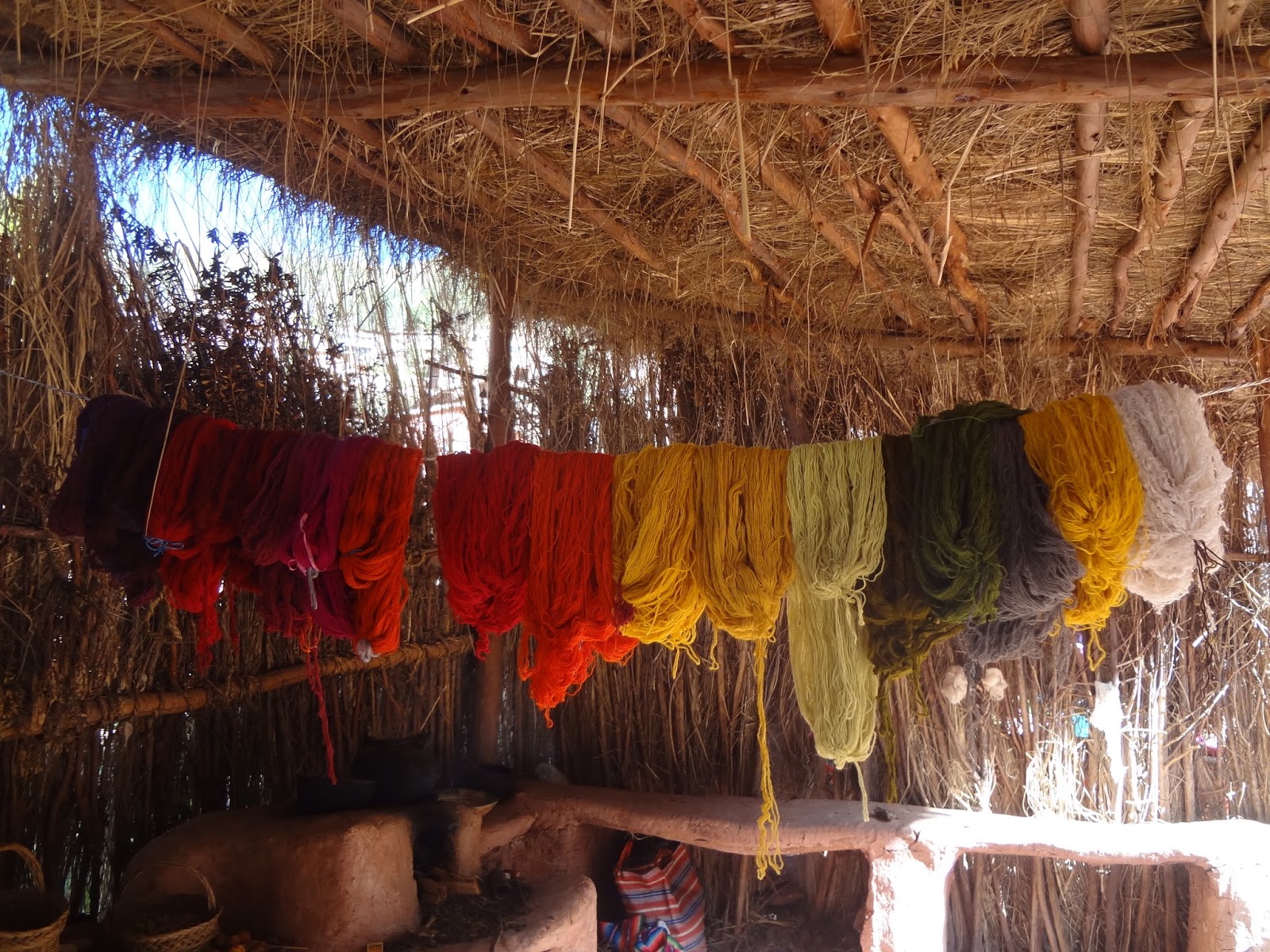

After the wool is spun, it gets dyed. We were shown techniques for tradition color making, such as grinding red beetles from the jungle, then mixing them with salt, water or lime juice depending on what shade of red you want. On the stove was yarn being boiled with a kind of leaf to get green.


Then they do the actual weaving.


The village market was several small stalls surrounding a main square where the women were weaving and spinning. After our lesson in traditional yarn making and weaving, we shopped around.


In Inca times, what the citizens wore signified where they came from. Jacket color showed region (red for the Andes, black for the Lake Titicaca region and blue for Quito area, for example) and each village had their own hat style and color scheme. The Andes is really the only place where this tradition is still happening, but you can certainly see many women in traditional clothes everywhere you go.


Another fifteen minutes down the road, we came upon the first views of what is widely known as the Sacred Valley, a fertile valley with a strong glacial river that flows to the Amazon. Much of the agriculture that sustained Cuzco and the Inca empire came from this are. Following the river the in photo below takes you to the base of the mountain where Machu Picchu stands.


Our first stop in the Sacred Valley was Pisac, a village in the valley below the ruins of an Inca city and terraces. Some things I noticed all the Inca cities have in common: terraces, which help to cultivate crops on the steep mountain sides, and keep erosion from getting bad. These can also be found on random mountain sides, built for growing food. The cities were also always high in the air, not down in the valleys. It seems that it makes good sense to keep your cities far away from a point they can be ambushed, and those that ran the cities were in charge of  keeping tabs on their citizens and who was traveling the Inca Trail - things that are easier done when you are above the people you are watching.

In the Inca class and societal system, every young male had to pay his taxes by doing manual labor 3 or 4 months a year, building cities on mountain tops or trails through the cloud forest.  The cities like this were inhabited by nobles related to the emperor, with working class farmers and llama herders in the mountains all around. Pisac was over taken by the Spanish and mostly destroyed, with stones used in the valley below to build the current city, but what remains is picturesque.


Then we went to Ollantaytampo, the closest the Spanish ever got to Machu Picchu and the second to last place the Inca Emperor made a stand before finally being captured and killed. There are signs in the city that it was never quite complete, and that the Inca stopped work here perhaps because they needed to focus on their battles with the Spanish, perhaps because they saw their inevitable decline anyway. Near the Temple of the Sun, one can see still stonework that was being fashioned and prepared to move to wherever its final destination would be. Trains come through this town on their way to Machu Picchu, full of tourists, and the shops and hostels in the village were quaint, but bustling. Before the sun set, just as it started to get chilly again in the mountain air, we climbed into the explored the old city.


Rosa, our guide, called this our "training" day for the Trail. It was her 189th time hiking the Inca Trail with G Adventures and she had a very good idea of how many levels to go up the terraces before a rest, then a few more before another in order to help us all acclimate. I think at this point all of us were looking at each other wondering how in the hell we were going to make it up Dead Woman's Pass, the second day of the Trail where you hike straight uphill 1000 meters, or about 3 or 4 hours, if we couldn't even climb some stairs without feeling our hearts jumping from our chests. (Spoiler alert: we all made it up the mountain two days later.)


Inca stone work is an incredible thing, especially when you consider how far they had to get these stones up the mountain, then put them into place, not to mention how many earth quakes they have survived. These walls were just below the Temple of the Sun, where the stonework gets more advanced because of the passing of years and gaining of knowledge, as well as intricacy given to a holy place.


This is the actual not completed altar of the Temple of the Sun, where you can still see the perforations in the stones which were used to move them (wheels were not used on the steep mountain sides) and which faces the sunrise on the Summer Solstice.


More explorations in the city.


Down in the modern part of the village, the streets run with ancient aqueducts and drainage systems to bring fresh glacial water through the village safely into the river beyond.


We spent the night in a hotel together, took final showers that night and ate a big meal, toasting to our last electricity, hot water and bed before we started the Inca Trail, which we would begin early the next morning.

Monday, July 29, 2013

Cuzco

The first thing I thought of when I booked the trip to Peru was the theme song from the Emperor's New Groove, the Disney movie which would not get out of my head well into the trip, especially when someone would mention it on the Trail. My friend Cassie and I watched that movie more times that I care to admit when we were in middle and early high school, spending many a drive to and from Minneapolis watching the movie on a car TV that plugged into the car lighter and played VHS tapes while it was propped carefully between the front seats of my parent's Ford Windstar. Naturally, Cuzco (the name of the unfortunately emperor who is turned into a llama and must regain his throne) came to my head a lot during my time in the city of Cuzco, and I'm sure to the annoyance of the locals.

Finally, we got out of the gloomy streets of Lima and made it to Cuzco, where we found ourselves opening our suitcases and pulling out hats and thermal layers immediately when out plane landed at 7am. We began wandering the streets of this high (11,000ft) Andean town as soon as we had dropped our luggage at the hotel and had a cut of coca tea to help with the altitude sickness, and soon the heat of the sun begged us to take off our thermals and fleece sweatshirts. 

My first cup of coca tea, and I ended up drinking it each day for breakfast, lunch and dinner. 
I can't say for sure if it helped with the altitude, but it tasted pretty good and was like a 
hot, black cup of coffee to the brain. Especially on the trail, the porters and locals chew and 
drink it for its caffeine and rush of adrenaline properties, which help you deal with the lack of 
oxygen.

Cuzco is a hub of tourist activity from all around Peru. Frankly, it seems most people skip Lima entirely and go straight here where they can enjoy the Inca ruins, Machu Picchu, get to the rain forest, lake Titicaca, mountain climbing or anywhere else in the country, really. This time of the year, when Lima is so bleak and cool, its not surprising, and in the summer when its beautiful in Lima its apparently a bit rainier and slower in Cuzco. Hotels are expensive, and locals selling hand-made alpaca goods abound. The old city center is still a quaint town with many small, winding, cobbled streets with a mix of Spanish and Quechua names, with mountains all around, filling up quickly with the shanty towns of the people from farther away who wish to cash in on the tourist capital of the area. The old center of town - which used to be Inca temples and palaces which were built directly over by Catholic churches and Spanish-style homes - was big enough to keep us busy all day, and to allow us to slowly adjust to the altitude. At this point in the trip I was altitude-sickness-free and loving it. 


Yes, this is a baby llama. We learned from our guide later that many of the children in the Andean region speak Quechua in the schools and only stay through the time they learn Spanish, which they at least need to participate in the tourist industry of the region. The outlying region around Cuzco is also majorly overrun by tourists, and nearly the entire economy of the community runs on tourism, whether it is through growing quinoia, making sweaters and table runners for the tourists or leading groups through the countryside, driving buses or acting as a porter on the Inca Trail.


Cuzco was absolutely the most beautiful city we visited, with many colonial touches, I imagine because it was the heart of the Inca Empire and the best way to ruin an empire is to replace their belief system with your own.

I could have spent many more days in the city, using it as a beginning ground for visiting local areas, wandering through more markets and really taking my time, but alas, we only had one full day at the beginning of the tour, and about 3 hours on the final morning before our flight back to Lima. There were plazas every few streets, beautiful buildings and an ancient vibe mixed with the new luxuries of places like Irish pubs and Starbucks. We sampled Alpaca meat and Guinea Pig, ate lots of qunioa and potatoes as well. You feel at the beginning and edge of something in Cuzco, like the best is yet to be found.


This is the central Plaza de Armas of Cuzco, highlighting a cathedral or two, as well as the most beautiful buildings of the city. It is one of the most photographed places in South America, so I won't dwell on the photos I took there. 

Quinoa soup

The mix of old and new, tourist and local in Cuzco. 


Cuzco from above, looking down upon the Plaza de Armas there from the hills above the city, which used to be the place of an Inca fortress, Saksaywaman, which the Inca Emperor took back from the Spanish after Cuzco was taken and from where he tried to fight back against the conquistadors. So many Incas were killed here in these battles, it was said the condors had a magnificent feast, and an image of eight condors on Cuzco's coat of arms to commemorate the dead here. After the defeat, the emperor retreated to Ollantaytampo, which I visited later.

Today, next to Saksaywaman (which is pronounced very similar to "sexy woman"), is Cuzco's version of the Cristo Blanco, not nearly as big as Rio, but lit up all night, and always overlooking the city.


From above, you can see how much Cuzco is growing as people leave the jungle the and countryside and come towards this city. In a perfect world I would have spent much more time there, but we had to move on, into the Sacred Valley where we began to find what remains of the Inca ruins and culture everywhere.

Saturday, July 27, 2013

Lima, Part 1

After 24 hours on the go, it was great to arrive in Lima and get picked up by Alfred's cousins, Karla and Carlos, who took us back to Karla's place about 20 minutes from the airport. Alfred's mom was from Lima, then lived in Venezuela for a few years before making her way to Los Angeles. While she was in Caracas, her brother Carlos came to live with her, and this is where Karla lived most of her life, and where Carlos was born. Alfred and his mom visited Lima a lot, but never Caracas and their paths had never crossed. So this was the first time Alfred had ever actually met his cousins, and it was very exciting for everyone. Personally, I had a great time talking to the Venezuelans, since its so rare to meet someone who knows anything about Venezuela, and I have been interested to hear the perspective of the people living there about Chavez passing away and Maduro taking over. (But don't worry, Chavez came to Maduro as a little bird at the beginning of the election campaign to bless him, and he's for sure the right guy for the job.)

Karla has been living in Jesus Maria municipality for about four months now. She lives in a 9th floor condo with three bedrooms and great city views, but a lot of chilly wind in the winter. Lima as a "city" would in some ways be better compared to LA as a metro area, including all the cities that lie around the main city. The whole area is split up into municipalities which have their own governing systems and taxes. The whole metro of Lima has 11 million people and is similar in sprawl to a big metro like LA, without many tall buildings until recently, like LA in a lot of surprising ways. 

We woke up to a cloudy, cloudy winter day, much like every other day I spent in Lima. 


Lima is in the literally the worst place on the entire west coast of South America. The way that ocean currents hit this 150 miles of land keep it at a steady cloudy and humid 62 degrees every single day all winter long, with 57 degree nights. I read in my guide book that the founders of the capital of the Spanish Empire in this region probably arrived in this location in the summer, when its in the 80's and sunny and beautiful every day in Lima and began building. I imagine in the summer the colors and characters of the city come out more brilliantly and fun than in the cold, grey winter.

We spent three days in Lima, visited Alfred's family members and friends, and did some of the tourist things he had never actually done before in his many visits. We began with a bike tour through the most metropolitan areas of the city, by the ocean. Yes, drivers in South America are terrifying, and it took a little bit to get used to the craziness of the city, especially on bikes. The thing I'm not sure I'll ever understand about drivers on this continent is the reasoning behind the honking of the horns. They do seem to signal things, and there is clearly an unspoken consensus for the rules of these streets, but I'd never get into a driver's seat myself there. It's better to just let the taxi driver go, not carry a hot beverage in your hands and not think about whatever it is your used to.

Anyway, on the bike tour, we got to see several huacas, pre-Inca ceremonial structures which sprinkle the city in the 100's. They suddenly rise up behind large cement walls, looking like they are just big piles of dirt, but then you notice they are made of ancient bricks, and you go in for a closer look.


I found myself soaking in as much information as I could about not only the Incas but the cultures that existed here before the Incas took over. The Incas are the most well known because they were the group that the Spanish actually came into contact with (and let's be honest, they were very advanced and facilitating group), but in actuality, the Incas were only in power for about 100 years before the Spanish came along the began taking them down systematically. For thousands of years before this, the rise and fall of highly advanced and interesting groups spotted the Peruvian landscape, and this region is considered one of the breadbaskets of civilization, on par with Egypt and Mesopotamia, with complex and rich cultures rising and existing at the same time.  


Lima is built along the ocean, but until about a decade ago, they didn't really use their ocean front for beaches or tourism. Now the city is working on building parks and beaches and accessibility to the great waves and ocean. Here is Miraflores, the most modern, hip municipality to live in right now, where the ocean project is completed. Lima officials are hoping that in a few years the city will also be known as a beach town. Not in their winter obviously, but I hear the swimming is good in the summer.


This is the Parque de Amor, the reason for which is rumored to be too many young people being too public with their displays of affection, promoting city officials to just make a place for them to go do their business in public. There were a handful of couples around this area, too, though I'm not sure how well PDA can be controlled.


This is Larco Mar. The city wanted a new cosmopolitan mall in the fancy Miraflores, but they didn't want to ruin the view from the nearby Marriott and other homes. So they built the mall along the cliff wall. You look at the park across the street and literally have no idea there is a huge, multistory mall full of discotechs and fancy restaurants in front of you, and hundreds of parking spots below you. Suddenly, it drops out underneath you in a flash of bright lights and hundreds and hundreds of people. This is the second most visited place in Peru, after Machu Picchu, of course.


The city center of Lima boasts a Plaza de Armas with a Cathedral (as they all have), the president's home and many federal buildings and hotels. Nearby are several other churches, museums and old winding colonial streets with European-style buildings of all kinds (in some neighborhoods, you'll suddenly see English tutor-style mansions next to more traditions adobe homes.)


This is the church and monastery of San Francisco, a Franciscan monastery. Wish I could have taken more photos, because they have a spectacular library fill of ancient books and huge choir books painted beautifully upon leather, so that they could be turned hundreds of times and the pages wouldn't break. The most interesting part of this church though, were the catacombs beneath, there I was able to sneak one photo:


The bottom of the church was sprawling, filled with piles of the bones of the citizens of Lima, arranged by body part, with a jumble of the smaller bones in a large pile near the door. The only extremely creepy thing about the place was imaging getting stuck down there in the event of an earthquake.

We celebrated the birthday of Alfred's cousins maternal grandmother, and it was great to meet a full family and share VERY sweet wine in toasts, as well as a big cake. Honestly, I felt like I was one of my uncle Dennis' Macalester exchange students, not quite able to keep up with the conversation in another language and letting myself drift a little bit, quietly in the corner, until someone spoke directly to me and asked me questions. Everyone was very kind though, and overwhelming as it was, I had a good night.

Karla, Alfred and I. 

Cousins: Alfred and Carlos 

Our final day in Lima we visited more of Alfred's family friends, and though it was very interesting to meet people and see more homes of the city, I found myself again quietly overwhelmed trying to understand the Spanish language enough to respond at all. At one of his family friend's houses, we did find some fascinating ancient art, from another pre-Inca society, picked up on a dig by her brother and hung lovingly in her garden.


In my opinion, Lima was interesting, but by far not my favorite city. Maybe in the summer, I would have liked it more. The clouds make the sprawl and grime (its a desert city, and it's hard to escape the layer of dirt on everything) and the honking cars and cold humidity seem rather unbearable. Have I mentioned the food yet, though?! The food in Peru, and Lima in particular, is actually VERY good, with lots of fusion and more Chinese take out places than America. At this point in the trip, I had not had a single stomach problem, which for me is huge. All in all, though, I was ready to move on Cuzco on our very early flight, the destination I was most looking forward to on the trip.

Friday, July 26, 2013

Mexico City

It has been nearly a year since I touched my blog. One of the reasons it let it slip out of my mind is that it felt quickly like too many things had happened that were worth sharing and it would be impossible to try to keep up. So I won't go into the last year. It's been a good one. I've got a great life: great roommates, good community, fun weekends, wonderful friends and lots of adventures. 

All of this culminated in a trip with Alfred to Peru from July 3 -23. When we first began dating, we went to an adventure vacation showcase fair in Long Beach. While we wandered from booth to booth, sampling adventures I felt I could never afford on my $400 per month Episcopal Urban Intern Salary, we found ourselves talking to a man from the G Adventures booth about Peru, Machu Picchu and the Inca Trail. I decided that day I was doing it. Summer 2013. It was happening. And by God, I'm good at keeping to my plans. 

So I'm picking up again to talk about Peru for sure, hopefully more as time goes on.  

On the way down, we had a 13 hour layover in Mexico City. Not only was this one of the cheapest ways to arrive in Lima, but it seemed like being in a major metro city from 5am to 6pm wouldn't be the worst thing in the world. I was a little nervous about Mexico City, with all the horror stories and worries about the dangerousness of the city I have heard over the years. But after some research on where to go and what to watch out for, I felt pretty secure that it actually wasn't going to be all that bad. And honestly, Alfred and I both agreed, after riding the buses, trains and walking through the city, we never felt in danger, or singled out for being American tourists. We had our backpacks on, we were the only Americans in sight, and everything went well and was easy to navigate. 

The day started off early (after a few hours sleeping on the airplane and another nap in the airport while we waited for the sun to come up) and we jumped on the bus headed for the Federal District and downtown. We went to the main square at Zocalo, which is one of the largest city centers in the world, with a huge plaza in the middle of Federal buildings and the Cathedral. On one side of the square there seemed to be a soccer tournament with many corporate sponsors being set up, on the other shanties for some kind of protest. Below the cathedral was the remains of the Aztec temples and pyramids which used to stand here. The Spanish liked to destroy whatever non-Christian religions they found wherever they went and put a cathedral right on top, we found throughout South America. 

We spent a few hours wandering around this main square and the surrounding streets. They were not busy yet, but there were clearly a lot of street stalls that would appear in a few hours when the crowds of the city center would come out in full force. 

 The Mexican flag rising above Zocalo Plaza with the Cathedral behind.

A closer view of the Cathedral, with one of the many shoe shiners in the area.  

The streets surrounding Zocalo before the crowds came forth from the buildings.  


After we wandered the area around city center, we caught an hour long bus and train ride to the southernmost end of Mexico City to Xochimilco, where the last remnants of ancient canals that used to run throughout the entire Aztec capital can still be found. Hundreds of painted boats, really they are gondolas, are manned by locals with long sticks to drive them through the rivers. Apparently on Sundays this place is crawling with locals boating and celebrating with flowers and their best dress, but it was a slow Wednesday, without many crowds. We haggled around, and grabbed a boat.


One of the other gondola drivers.  


This was the food boat, which pulled up along and asked if we wanted to eat, then pulled up behind and cooked the food in a few minutes. We enjoyed tacos, rice, tacitos and plenty of sides. There were boats with mariachi bands floating by offering to play for you for a price as well. We rode along the canals for about an hour, but could have gone out for up to 4 hours if we had the time and money, out to forests and animal reserves. It was quite a cool side trip down to the edge of town. We wandered around the local markets afterwards, before making our way back north towards the airport.


When we got back to the airport, we found ourselves seeing white people for the first time all day at the gate going to Peru. It may have been the only day of the whole vacation where I truly felt like I wasn't a tourist surrounded by other tourists - more off the beaten trail, if you will. Our flight to Lima was from 6 to midnight, and I was able to grab a few more hours of sleep before we landed to meet Alfred's cousins at the airport.

Wednesday, August 22, 2012

Sea Creatures

One thing I've learned in California: I am not a sea creature. Rather, I am a fresh water mammal. There was always a mystique about running and diving into the ocean and swimming like one does in a lake, slowly and calmly, but this is much harder than it sounds, especially for a woman who was raised in fresh water lakes and swims with her mouth slightly opened, spitting out water as she resurfaces. This is not possible with sea water. Plus, you can't really just dive in, you have to focus on the waves, when they are coming, how big they are, will they crash against your head, pull your swimming suit off, knock you against the ocean floor or pull you off your feet during the rip tide? Plus the Pacific Ocean is cold. At least in Venezuela it was the Caribbean ocean. That was better.

Ok. I'm being melodramatic. Living near the ocean is great. I realize I have no place to complain. Maybe I just make myself hate it a little because since it takes so long to get out there from Pasadena, I don't get out to the beach enough. Between the traffic, parking, hot sun and impending drive back home, I've found better ways to pass beautiful summer weekends. But this summer I have not gone to the beach as much as I should. End of story.

I was actually complaining about this today with my coworkers, saying I wished I had made an effort to get to the ocean more often this summer. I mean, it has been a very busy one so I have a whole summer full of weekends of excuses, but still. When my friend Lauren was in town we spent the day in Malibu, and I swam in Minnesota a few weeks ago, but come on, I live in southern California, NOT that far from the beach! As my coworkers and I are finishing up this discussion, the fire alarms go off yet again in our office. The school I now work at is doing construction in a new wing before students come back and today the internet, phones and network were down, then the fire alarms started going off randomly. It was around this time that the Head of School alerted us that we should just go home for the day. It was 10:30, and I decided not to think too hard about it and drove straight to Santa Monica after grabbing my bathing suit from home. As far as I saw it, I had the whole day, a book to finish and lunch already packed.

And it was the prefect day at the beach. Traffic getting to the beach was not awful, it took me no time to find parking, there were not many people on the beach because LA school districts have started school now and the CRAZY heat wave we've been in has kind of broken. It was sunny but not hot, warm enough to get into the water and swim. And the waves were manageable. I could swim and ride them and didn't feel nauseous from the brine when I got out of the water!

So does this mean I'm getting used to the briny salt water? Becoming a new kind of mammal? I know that I have not yet gotten used to the heat here, that's for sure. I'll keep you posted on the ocean, as I make an effort to go more often.

Wednesday, July 18, 2012

The Birthday

Most people don't want to talk about how old they are on their birthdays because they don't like to admit how many years they've lived. I am actually the opposite. I don't like talking about how young I am. For a while now I've had friends who are all older than me. At the University of Minnesota, the people who I was most likely to spend some significant time with were people who would look at me curiously when I said "I have to go write a paper now." Suddenly they would say "OH right! You're still in college." Once again, I find myself becoming good friends with people who are old enough to say "Oh wow" and look wistful when I tell them my age. There is nothing exactly wrong with this, but it makes me feel like I have to prove myself somehow - like show that even though I'm younger I deserve to run in their crowd. I feel like I fit in just fine. I was telling a friend the other night that I think I hit my hay-day when I was 13 and 14 the staying up till 4AM writing every night. Now that most of the people my age are up clubbing and dancing till 4AM, I've passed that prime and just go to bed at 11 like a normal person. Anyway my birthday can be weird in that respect: I don't like admitting my age just as much as the next girl, but for completely different reasons.

This year, there was a lovely birthday party outside with fresh food and wine with some good friends, which was perfect. I also learned recently that on your birthday, you can go to Catalina Island for free. This is a tourist haven on the chain of Channel Islands about 20 miles off the coast of LA, where you can camp, swim, shop, boat and stay in luxury hotels. Whatever floats your particular boat/budget. Also on Catalina Island is Two Harbors, California, which, having the same name as my hometown in Minnesota, is a place I feel I should take a picture of myself. Typically the ferry ride is $72 a person both ways, so getting one of the tickets for free is really what made the whole trip affordable. Because of the crazy cost, though I would have loved to take all my friends and spend the day running around together, it was only Alfred and I, which was also really great. 

When we arrived in the morning, there was a bit of marine layer of fog and clouds, but we could see the sun starting to burn it off in the distance, so we decided to get a huge breakfast and waste a little time.


By eleven thirty the sun had worn off and we spent the day walking around Avalon, the main town, kayaking and snorkeling. I have never been ocean kayaking, and the water and waves and sun were prefect. The water was a deep sapphire blue and from the surface you could see the massive kelp forests and rocks below. I did go snorkeling in Cancun a few years ago, but this time was so much better. There were more fish, an amazing kelp forest to explore and a ton of brightly colored and hungry fish who were getting fed by more of the other snorkelers and there very friendly because of this. Of course the Pacific is much cooler than the Gulf, so the water was not bath-warm, but having grown up swimming in Lake Superior, I could handle just about anything for 20 minutes.


 There are no cars allowed on Catalina, apparently, so all of the people drive golf carts. And live in tiny houses, I guess. 


Catalina is a place I've been meaning to get to  (partly because they mention it in Arrested Development) so this was a great way to spend my 23rd birthday (there you go - now you know how old I am).