Sunday, August 4, 2013

Inca Trail Day 3

The third day of the Inca Trail was probably my favorite. Maybe it was because I felt a lot better, maybe it was the going down and down and down the mountain, maybe it had to do with the unbelievable views and maybe we were finally hitting our strides as hikers and enjoying each other's company more and more. 


You can see the Night 2 campsite here, and in between the two tall mountains, Dead Woman's Pass, which we crossed over the day before.

The day started out with more uphill, not quite as high as Dead Woman's Pass, but about an hour going up, stopping along the way at a way-station which would have been more or less a hotel for those making the pilgrimage along the trail, standing guard against anyone who might have not been allowed on the route.


Made it to the top of the next pass in one piece, though it's not fair to say I felt TOTALLY better. I still wanted to curl up in a ball and cry, but I was not throwing up any more, so I suppose my memory would tell you that I was feeling great at this point. From the top of the pass, we could see snow-capped glacial mountains, and towards Machu Picchu mountain. After another deep inhale of the flowery alcohol solution, my lungs opened up and I felt pretty good.


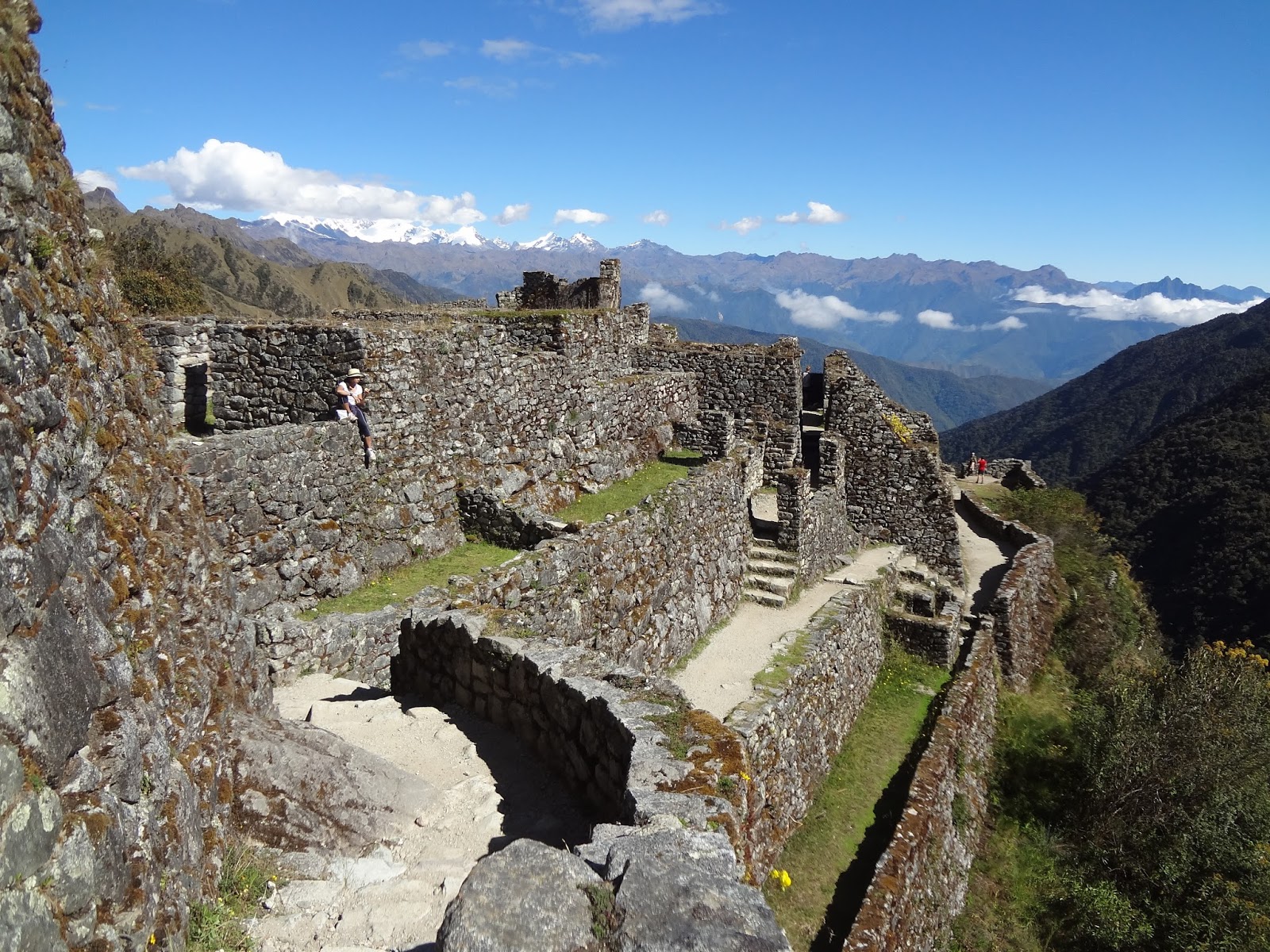
Once we reached the top of the pass, we hiked for several hours rolling up and down along the top of the mountains, following the path through caves, more ruins, lots of llamas and the beginnings of the cloud forest, where we were told to anticipate some rain, but found nothing but sun filtering through the trees and hanging moss.


We ate at the top of the final tall peak that day. After lunch, the cooks brought out a frosted and beautiful cake for Alex, a police officer from Manchester, who was celebrating his birthday. Apparently they steam-cooked this masterpiece, and even wrote his name on it. After blowing out the candles, they cut it up and we enjoyed just one more thing we never thought we'd be given while in the wilderness.


All of our porters, guides and cooks on the last day. Remember there were only 16 tourists this group of 21 cared for on this trip.


After lunch, it was time to begin the descent lovingly named "The Gringo Killer". This was 2-3 hours of straight downhill stairs, winding steeply through the forest, with a foot or more between many of the steps. The most terrifying part of this trek was the porters who would come up behind you at a jog, propelled down the mountain by the sheer weight of the bags on their backs. The shout of "Porters!" was common throughout the trail, but here it spurred a moment of panic as you jumped to the left and hugged up against the mountain so you didn't get carried down with them.


This part of the trail was probably my favorite, as we descended into the cloud forest, where it became more humid and green. The ancient trail is still totally intact here and I couldn't be happier to be going downhill, no matter how steep the steps. After days of feeling awful due to the altitude, I realized that my months and months in the gym had actually payed off on this third day, when I felt pretty strong going downhill for hours on everyone else's least favorite part of the trip.


If you had taken the train to Machu Picchu, this is the river you follow through the mountain valleys to arrive at the city. Joining up with the sounds of the trains below felt strange, but not as strange as arriving at the bustling tourist location the next morning. We were on the south side of Machu Picchu mountain that final night, with only a few more kilometers to arrive at the ancient city - the final bit we'd take in the dark hours of the morning to see the sunrise through the Sun Gate.


That last night we stayed at what is the busiest campsite of the trail. More or less all 500 people who are on the Trail on a given day stay here their last night so that they can reach the city for the morning sunrise as soon as the last checkpoint opens at 5:30am. We had a nice night together, now that the group had really gotten to know each other and the hard work was more or less done, opening a bottle of wine to toast the two couples who were on their honeymoon and playing cards before and after dinner. It was an early night, though, since we were getting up at 3:30 in the morning the next day to line up for the last mad dash to Machu Picchu.

Finally at the site - the best part of each day. 

Saturday, August 3, 2013

Inca Trail, Day 2

The second day on the Inca Trail is the hardest, by far. You spend the first 4-5 hours of your day going up 1000 meters of stairs straight up the mountain (who had time to make switchbacks when they had to build 82 kilometers of trail from Cuzco to Machu Picchu?), then another two hours going straight back down the other side to the camping spot. I didn't feel like we covered much ground at all, just went up and down. Luckily I woke up feeling much better than the night before and at all the quinoa porridge given to me and a cup of tea. From our camp site, Rosa pointed out where we were going that day - straight up and over the tiny knob you can see in the photo below, between the two mountains rising around. 


The first part of the trail that day was forested and beautiful. We walked alongside a river, began going up stairs, but had been acclimated to the height at this point, so we were all doing alright. I felt great, and with frequent rests, was sure the day was going to be just fine.

Getting passed up by locals along the trail.  


At this point, now that we were outside of the villages and starting to get into the wilderness, the ancient stonework of the trail itself was becoming more visible. Rosa said this trail took hundreds of years to build, and each stone was placed particularly to make these ancient stairs, matching the others around it in height.


We hit the treeline and found llamas and sheep all around. A few more women waited here selling everything from beer to pringles, and the wind had picked up enough that we were still wrapped up in our hats and jackets, just trying to make it to where the sun shone and we knew we'd be warmer. From here, Rosa wasn't going to help us keep pace - she would walk at the end of the group, and encouraged us not to rest longer than we hiked, and to wait at the top of the pass for her.

At first, I was still doing good, but I quickly lost pace with the group of the youngest people who walked ahead. We found ourselves in the hot sun, and the layers quickly came off, and I quickly slowed down. Altitude sickness is a hard thing to describe, its not like anything hurts exactly (unless your getting headaches, which I wasn't) and even though your panting, its not exactly like your out of breath in a new way. For me, it's this profound uncomfortableness, this sense that I want to crawl out of my skin because I feel so plain awful. I was moving slowly, and needed to rest every five steps or so. Finally, Rosa caught up to me, and tried an herbal remedy: this flower infused alcohol which she made me sniff. I coughed, and felt my lungs opening. This worked for about 20 more feet, but I was resting with my head between my legs now, moaning. So they pulled out the big guns. I'm a little ashamed, since I did train, and I do hike and camp a lot, but I know there's not much you can do for altitude. It either hits you or it doesn't, and it was REALLY hitting me this time.

They lay me down on the ground with my feet on a rock, and gave me five minutes of straight oxygen. I didn't immediately feel better, but when I kept smelling the alcohol/flower solution and threw up one more time, I was able to make the last couple hundred feet to the top of the pass without too much struggle.


Here we all are at the top, looking back down on the way we had come that morning, down at the bottom of the valley.


And this was the way forward, down the mountain, where I rushed. There was about two hours left of steep stairs to get down to the camping site for the night, and I was happy to go to a lower altitude. The whole time I hiked, I wouldn't say that I felt a lot better, but going down was at least a better feeling than going up, and the hours in the gym before this trip came in handy on the many many downhill stairs we traversed.


Made it down the mountain to the camping spot for the night, where we ate a late lunch and I curled up in the shade and slept off my remaining nausea and altitude sickness. For the rest of the trip, I more or less felt stable and healthy.


As I said, every time we were to eat, there was fresh warm water for each of us to wash our hands in, and the table in the eating tent was set with table cloths, and on Day 2 there were napkins folded into baby condors. Quite fine dinning. Each meal was excellent - beginning with soup, including a great meal and ending with dessert and tea. It was incredible what the cooks could produce, given the circumstances and a simple stove. Rosa said that they always carry the same ingredients, but make new and interesting dishes on each trip.


Being in the Andes, at the high high altitudes, as you can imagine, the days are hot, with strong sun, and the nights got cold fast. The second night, just below Dead Woman's Pass, was the coldest, with lots of wind running up along the valley we slept in. The canvas walls of the dinning tent and sleeping bags we rented back in Cuzco were great, though, and with a layer of thermals, I had no complaints of cold as soon as we settled in.


I ate with a totally recovered appetite that evening, and stayed awake to get clobbered in a few games of Uno before crawling into the sleeping bags for the night.

Inca Trail, day 1


We arrived at the trailhead around 9 in the morning, after a couple hour drive from Ollantaytambo. The Inca Trail is pretty well regulated at this point - you need permits, the porters need to have their bags weighted several times along the way to be certain that they are not being abused - so it took a while for us to get on our way once we arrived. The Peruvians are also a little passport-stamping crazy and will stamp your passport virtually everywhere you go if you'd like. So I got a stamp the day I started the the trail and the day I arrived in Machu Picchu, which was pretty spectacular. Once we got our permits and passports cleared, as well as our group photo at the beginning, we set out.


From here, if you're not taking the Trail to the city, you are on a train, following the river. It's about an hour and a half from here to get to Machu Picchu on the train.


Porters running ahead. They would clean up camp after we left and run ahead of us about 20 minutes later, then set up lunch before we arrived, then run ahead of us again to have the tents and dinner ready before we got to our final spot of the night. At first I felt a little colonialist and weird about having porters carry all my stuff, but then thinking about it, and talking to them, it seemed to be a pretty good job to have between working in the farms with your family - they'd work for 4 days on the trail, then get a week or so off - and hiring local people is always a good thing. I read a lot about porter abuses before I left, but I also read that things are a lot better now, and saw that. And these men earned every cent they received - running along these mountains with huge bags on their backs!


The first day on the trail was rolling hills and not too difficult. We went about 11 kilometers all day - we actually never traveled all that far each day, but the altitude and terrain made it difficult enough that this afforded everyone time to go at their own pace. In the beginning, Rosa our guide walked slowly in front of us so that we'd pace ourselves, and we'd rest every 25 minutes or so to let everyone catch up. We had people in our group ranging from 20 years old to Frank, who was a fantastically good-spirited Hungarian in his 50's or 60's who had once competed as an Olympic weight lifter and who ended up arriving to campsites before everyone else on the last day.

There were still lots of villages and locals along the trail at this point - even some donkeys and horses, which would never be able to make the trail in the following days. Some people in the group were feeling sick in a few different ways, but I was - to my great surprise - doing fantastic so far. The final 20 minutes of the hike that day was the beginning of the steep steep ascent to Dead Woman's Pass - at more than 14,000ft - and as we began to ascend, all of my calm, delighted feeling-good slipped away and nausea began to rise.


Every day when we stopped for lunch and when we arrived at the campsite, we would find buckets of warm water heated by the porters, ready for us to wash our hands and faces. These sorts of luxuries seemed outrageous, but quickly became delightful as the days went on. And for the price we payed, it seemed to fit in.


There are no fires allowed on the Trail, so the porters needed to carry propane and all meals were cooked over stoves in the cooking tent. There was also a eating tent, and the porters had a tent to sleep in. Each night, at about 5:00, we had "tea time" where we would drink a cup of hot tea or coffee, and snack on popcorn. We played a lot of cards between tea time and dinner, then usually it was early to bed.


That first night, we all gathered to introduce the porters and cooks and us travelers before tea time. Rosa translated from Quechua to English, and we met the men from the surrounded villages who carried our stuff. As we were introducing ourselves, I was last in the circle and my nausea was rising and rising. As my turn came, I ran off down the hill and threw up for the first time that night. I had spoken too soon and now the altitude was hitting me. I spent the rest of the night curled up in the tent, trying to eat a little, and getting sick again and again. Luckily, once I feel asleep, I slept deeply, feeling much better at 6 when they came around to wake us up before the sun rose with a cup of hot coca tea.